
Tummy Time Tips: Building a Strong Foundation from Day One
March 21, 2025 • WellCare & Nurture Team
Why Tummy Time Matters
Tummy time isn't just an exercise — it's the foundation for nearly every major motor milestone your baby will achieve. Rolling, crawling, sitting, and eventually walking all begin with the strength and coordination developed during tummy time.
The American Physical Therapy Association (APTA) and the American Academy of Pediatrics (AAP) recommend supervised tummy time starting from day one, building up gradually as your baby grows.
Here's what tummy time develops:
- Neck and head control — essential for safe positioning and visual tracking
- Core strength — the foundation for sitting, crawling, and walking
- Shoulder stability — needed for reaching, grasping, and eventually writing
- Visual development — practicing looking at the world from different angles
- Prevention of flat spots — reducing the risk of positional plagiocephaly
"But My Baby Hates Tummy Time!"
This is one of the most common things we hear — and it's completely normal. Many babies fuss during tummy time, especially at first. Their muscles are still developing, and the position can feel unfamiliar and hard.
Here's the key: short and frequent is better than long and miserable. Start with just 1–2 minutes at a time, several times a day, and gradually build. If your baby is crying, it's okay to take a break and try again later. We never want tummy time to be a stressful experience.
Making Tummy Time Enjoyable
For Newborns (0–6 Weeks)
- Chest tummy time — lay baby tummy-down on your chest while you recline. Skin-to-skin makes it cozy.
- Lap tummy time — lay baby across your lap and gently rub their back.
- Burp position — holding baby upright against your shoulder counts as tummy time!
For 2–4 Month Olds
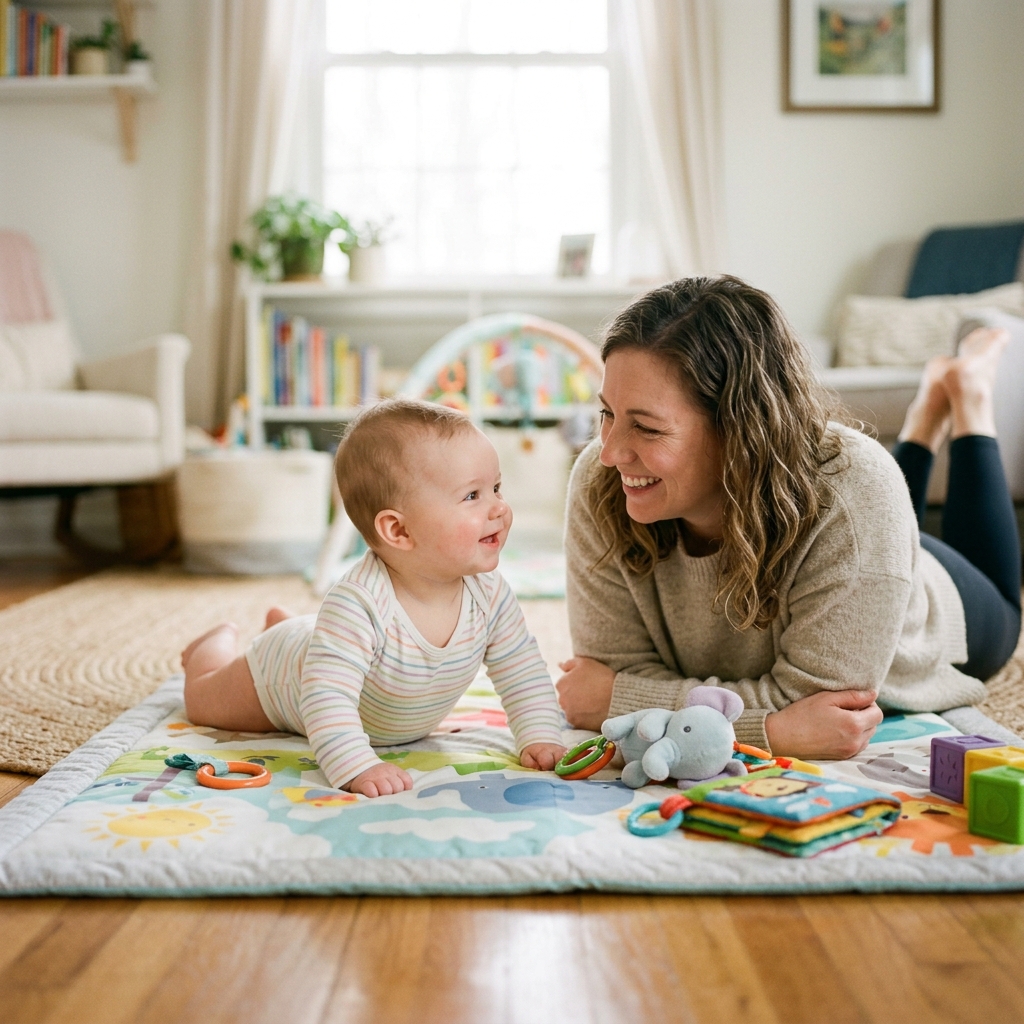
- Get on their level — lie on the floor face-to-face. You are the best motivation!
- Use a rolled towel — place a small rolled towel under their chest for a little lift and support.
- Prop with a Boppy — a nursing pillow can help them get into position more comfortably.
For 4–6 Month Olds
- Toy motivation — place colorful toys in an arc in front of them to encourage reaching.
- Mirror magic — a baby-safe mirror in front of them is endlessly fascinating.
- Airplane rides — hold them horizontally and "fly" them around the room. It's tummy time in disguise!
For 6+ Month Olds
- Obstacle course — place pillows and cushions to crawl over during tummy play.
- Ball play — roll a ball in front of them during tummy time for reaching practice.
- Sibling involvement — older siblings lying on the floor with them makes it social and fun.
How Much Tummy Time Is Enough?
The AAP and APTA recommend working up to 60 minutes total per day by 3 months of age. But that doesn't mean 60 continuous minutes! It's spread throughout the day in small bursts:
| Age | Duration | Frequency |
|---|---|---|
| 0–6 weeks | 1–2 minutes | 3–5 times daily |
| 6 weeks–3 months | 3–5 minutes | Throughout the day |
| 3–4 months | 10–20 minutes | Multiple sessions |
| 4–6 months | 20+ minutes | As tolerated |
When to Talk to a Physical Therapist
Most babies gradually warm up to tummy time with patience and creativity. But if you're noticing any of the following, it might be worth a conversation with a pediatric physical therapist:
- Your baby consistently turns their head to only one side
- They seem unable to lift their head at all by 2 months
- They arch their back and become very rigid during tummy time
- They're not showing progress despite consistent practice
- You notice a flat spot developing on their head
These can all be addressed early with gentle, play-based physical therapy — and earlier is always better.
Trust Your Instincts
Every baby develops at their own pace. Some love tummy time from day one; others take their time warming up. Both are normal. What matters most is that you're showing up, trying, and connecting with your baby through the process.
Learn about our physical therapy program or contact us for a free screening, or try our Little Leaps Milestone Checker to check in on your baby's motor development.
This article reflects current guidelines from the American Physical Therapy Association (APTA) and the American Academy of Pediatrics (AAP). For more resources, visit apta.org.
Is your child showing signs of needing support?
If the topics in this post sound like your child, our team of pediatric specialists is here to help. We provide personalized ABA, Occupational, Physical, and Speech Therapy in Colorado Springs.
Schedule a Free Screening